

This post contains affiliate links. When you purchase through links on our site, we may earn an affiliate commission. Learn more about it here.
I was under the impression that the Deleter inks were perfect for my dip pen, until I discovered the better alternative, the Kuretake Zig Cartoonist Black Ink 60.
In fact, it might even be the best dip pen ink that you can get for almost any type of application.
Table of Contents
What is Kuretake Zig Cartoonist Black Ink 60?
Kuretake Zig Cartoonist Black Ink 60 is a black pigmented ink made in Japan. There’s also Kuretake Zig Cartoonist Super Black Ink 60, which is a better version of it, but it is slightly more expensive. If you’re on a tight budget, the regular Black Ink 60 might just be the perfect option for you.
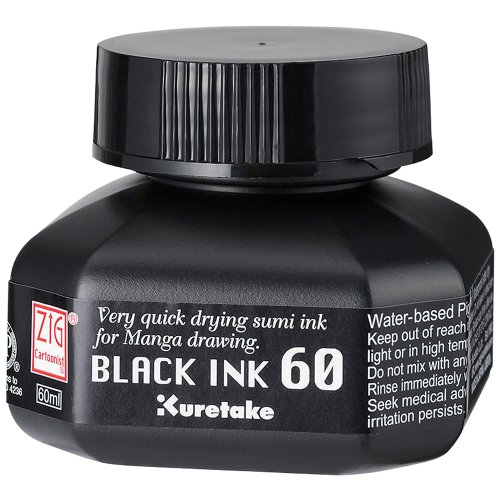
The ink comes in a 60 ml black plastic bottle. It has a rather large lip so it’s easy for you to dip the ink with a dip pen or even with a brush!
On the bottle, they claim that the ink dries very fast, which is one of the main selling points of this ink. So how long does it take for the ink to dry? Check out how I test the drying time down below in the later section of this post.
Availability

I couldn’t find this ink in any local craft stores near my area. It’s not even available on Amazon Germany! I later found an amazing deal online from a stationary store somewhere in Sweden, so I decided to grab it.
They shipped it all the way from Sweden and it took about a week for the package to arrive, which wasn’t a big deal. More importantly, the package and its content came undamaged.
If you’re located in the US or somewhere else outside of Germany, you can get it here:
Kuretake Zig Cartoonist Black Ink 60
- Waterproof after it dries
- perfect for ink pens
- quick-drying sumi ink
- highly opaque, deep black color
Matte Black Finish
The ink has a matte black finish, though it could have a slight sheen to it. It’s not that apparent though, so you could never tell if you don’t take a really close look at it.
Blackness
The ink is deep black. I compared the ink with 3 of my favorite pigment fineliners; Copic Multiliner, UniPin fineliner and Sakura Pigma fineliner. To my surprise, Kuretake ZCBI60 is the darkest among all those tested fineliners.
The picture below doesn’t really do its justice, you need to see it in person to be able to tell the difference.

Its big brother, the Kuretake Zig Cartoonist Super Black Ink 60 is claimed to be even darker than the ZCBI60, so if you don’t mind spending more money to have that that deep saturated black ink, you should certainly get your hands on the ZCSuperBI60.
Drying time
So how do you test the drying time? To get a more accurate and reproducible result, I used a test method that’s inspired by ISO’s (International Organization for Standardization) drying time method for pens.
The drying time is essentially the time that the ink takes to become non-transferable either to skin or to paper. Of course, if you were to do this test with your fingers, you’ll end up with black fingers!
So they tell you to use an eraser instead. The rule is simple, you draw a straight line on a paper, then use the eraser to rub it once perpendicularly across it. The ink is considered dried when the eraser no longer smears the ink.
The eraser has to have a certain hardness, but since it’s going to get quite technical, I’m going to keep it short: you will need to use a natural rubber eraser. (more about types of erasers here).

They also say to use a specific writing speed, writing angle and pressure but if you want to try do the test at home, chances are, you can’t control all those test parameters. So just draw a line like you normally would. That’s how I did my test too, I drew the lines using normal writing speed, angle and pressure.
So I did the test on 3 types of papers: 80gsm cheap copy paper, 100gsm copy paper with a smooth texture, and 140gsm sketch paper. I rubbed the lines every 5 seconds and stopped the time when the ink stops to smear anymore.
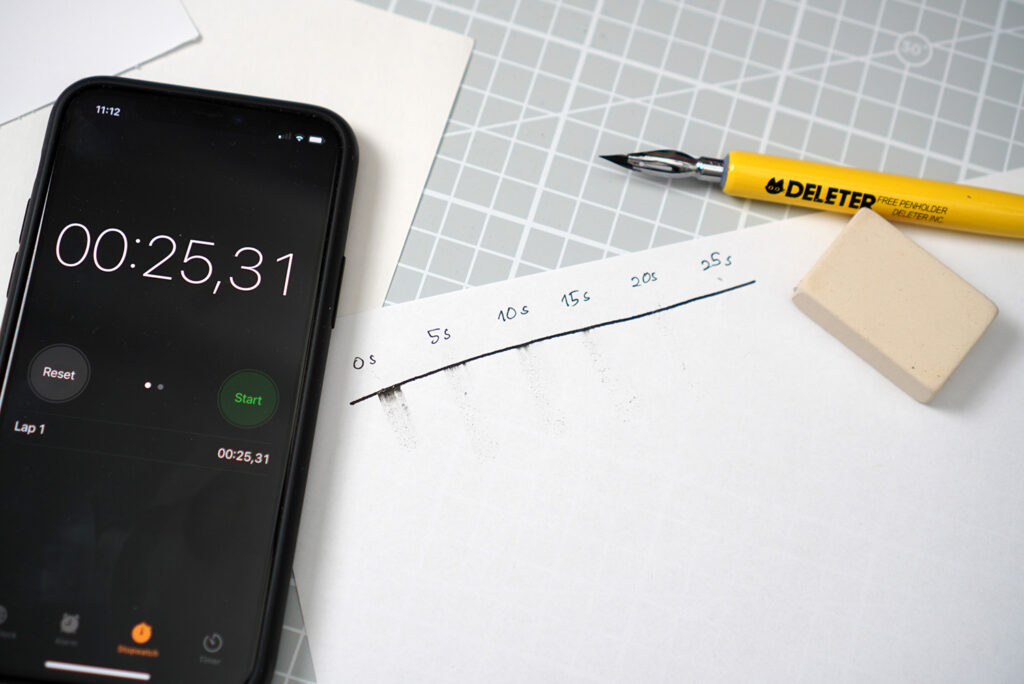
So here are my results:
| 80gsm copy paper | 100 gsm copy paper | 140 gsm sketch paper |
| 1st test: 20 s | 1st test: 30 s | 1st test: 30 s |
| 2nd test: 20 s | 2nd test: 35 s | 2nd test: 45 s |
I’m pretty happy with how the results turned out. Of course you can’t compare its drying time with the drying time of fineliners, but considering the fact that it’s a dip ink, the drying time is really very good! I mean the ink dries under 1 minute, that’s commendable!
Nevertheless, you shouldn’t take these results at face value. There are so many other factors that could influence the drying time like the type of pen, the temperature and the humidity of the room and so on.
So try to recreate this test yourself at home and see if your results match mine!
Waterproof
Although it doesn’t say on the bottle itself, a lot of retailers claim that the ink is waterproof when dried. If you think about it, it makes sense since the ink is a pigmented ink.
In short, pigments are like very, very little color particles that are suspended in liquid, which give the liquid (or ink) its color. The liquid may mix with water, but the pigments themselves don’t.
So let’s test if the ink can withstand water! Let’s use the ISO’s water resistance test method for this test. Yes, I know that water-resistant isn’t necessarily waterproof, but it’s the next best thing we can rely on to get an idea on how it behaves with water.
So according to the ISO, you need to let the ink dries for 2 hours first. After 2 hours, immerse the paper in distilled water for 1 hour, then remove it and let it dry. If the ink is water-resistant, the line should still be visible on the paper.
For this test, I drew a couple of lines on those 3 types of papers again. However, I didn’t use distilled water though, just normal tap water.


Here is how they look like after immersed in water for 1 hour and dried under the sun for about 1/2 hours:

Look how you can still see the lines very clearly. There’s no smearing, no feathering and no staining of the paper whatsoever. So is the ink water-resistant? 100%!
Bleeding of ink
The ink is water-resistant, that’s for certain. But you have to keep one thing in mind. Ink bleeding can still occur. So what do I mean by bleeding?
If you take a paint brush and try to color your drawing with water, you might see some smudges. But you will notice that the lines don’t feather out and don’t blend in with the smudge. There is a clear border between the lines you draw and the smudge.
So how is that possible?
Since the ink is comprised of tiny little particles, these tiny particles may sit loosely on the top surface of the paper. By introducing water with a paint brush, you are physically pushing them out, hence the smudges.
So I tested the bleeding of ink by drawing a few circles. After 2 hours, I tried to color in the circles with water using a paint brush.
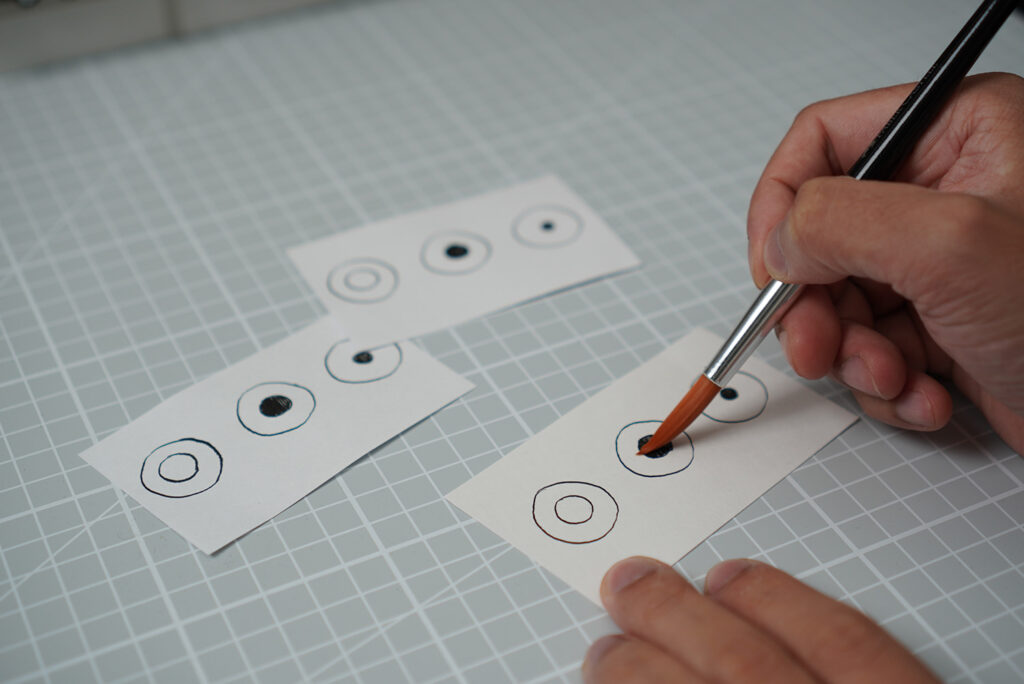
And here are my results:


As you can see, there’s moderate bleeding of ink where the colored area is larger. On the other hand, the bleeding is almost negligible where there are thin lines.
So if you’re coloring your drawing with watercolor, it might be a good idea to avoid coloring in a large area with the ink.
Depending on the type and the quality of the ink, bleeding might be unavoidable.
Safe to use with alcohol-based markers
The ink is alcohol-proof, which is perfect if you’re trying to color your drawings with alcohol-based markers like Copic markers! In fact, this is the main reason why I got this ink!
So I tested the ink by coloring in the circles and the area around it with Copic markers and here are my results:

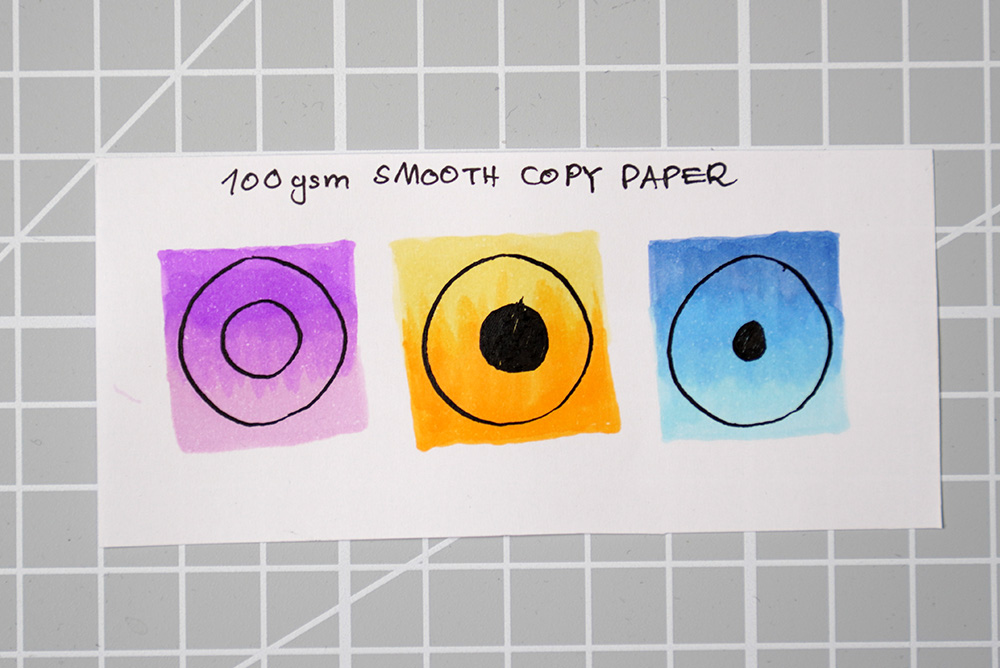

Just as advertised, there’s no smudge and there’s not even any bleeding at all! This is the reason why the Kuretake ZCBI60 is the best ink to use with Copic markers.
Conclusion
So if you use a dip pen to draw and plan to color your drawing with alcohol-based markers, this ink is perfect for you.
However, you shouldn’t use the ink in a fountain pen. One important thing that we learnt is that the ink is a pigmented ink, so those little pigments may very well clog your pen.
If you use a dip pen, make sure to clean the nib after each use. Just rinse the nib with water and scrub the nib lightly with a paper towel. That usually does the job.
To wrap it up, here are the reasons why you should get the Kuretake ZCBI60:
- Very dark pigmented black ink
- Matte finish, with slight sheen
- Dries fast
- Waterproof when dried
- Safe to use with copic markers